


- By Rawat Admin
- In Academic ,
- Posted December 23, 2025
- Views 346
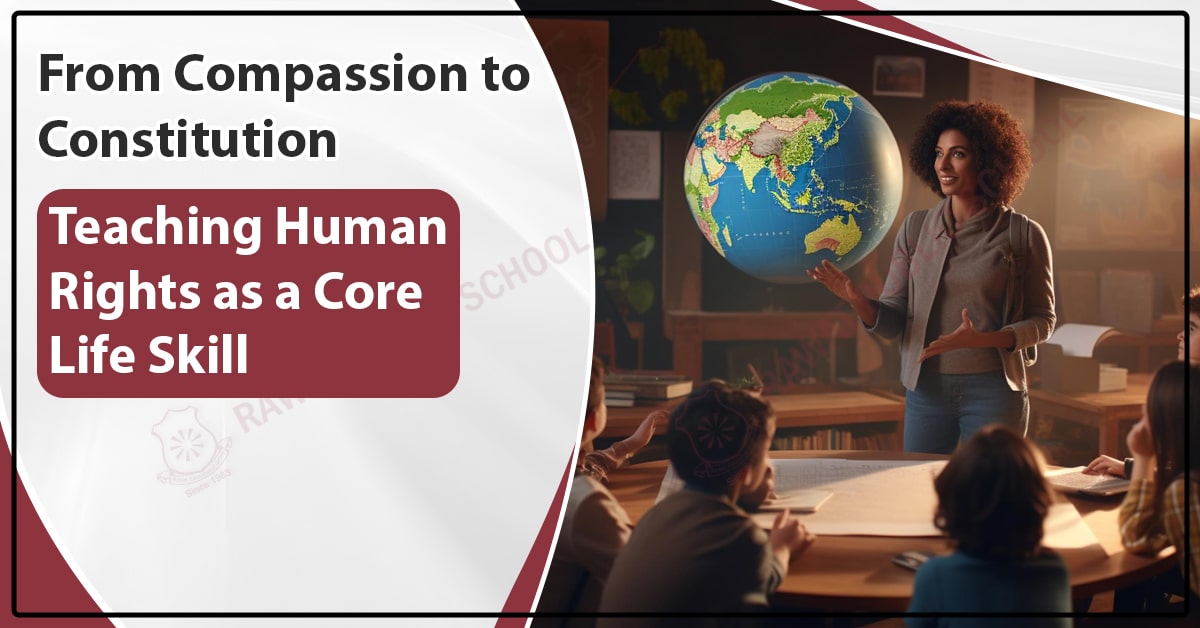
From Compassion to Constitution: Teaching Human Rights as a Core Life Skill
Children are the ones who are growing up in such a world that they are connected to the whole world in a way that has never been the same before. They get to see the news of all the negative and positive things going on in the world like wars, inequalities, and protests, as well as the good things that happen and how things change—all this happens even before they really know how the society that they live in works.
That is the reason why the human rights education should not be limited to textbooks or special occasions and should be rather developed as a core life skill, which is then guided by the Constitution and is also based on compassion.
The so-called human rights education is not only about knowing laws or reciting articles. It has become the process of equipping the minds of the young with the concepts of dignity, justice, and sympathy—these are the basic manners how a person treats others and how he/she expects to be treated.
The Importance of Human Rights Education Today
A child does not come into this world automatically knowing what is “right” or “wrong”—he/she learns it through different ways: by experience, by talking to other people, and by observing the behavior of others. Justification of this is the dissemination of human rights awareness among students:
- Acknowledge their own and others' value
- Know the concepts of fairness, equality, and justice in their everyday lives
- Mechanically but politely oppose discrimination or victimization
- Cultivate sympathy for people of other races and cultures
All the children who are taught the thinking of everyone having the right to be treated respectfully will be the grown-up who do not only obey the laws but also comprehend the reason behind such laws.
Teaching Empathy First: Coming from Compassion
No constitutional words or legal terminologies should be used in teaching human rights—education should start from compassion instead.
Classroom meetings on simple topics are the very beginning of students experiencing the most powerful breakthroughs in understanding their own state of being:
- What if you were not invited, how would you feel?
- Can anyone say a word without a reason to do so?
- What aspects make a rule either good or bad?
Using stories, role play, group activities, and real-life situations, the little ones are able to see the world from a different perspective. Compassion helps them realize that the rights are not just abstract concepts—they are about people, feelings and lives. This emotional base is very important. Empathy makes the whole situation very personal while in the opposite case people's rights would be seen as unfriendly and far-off.
You can also read:- Top 10 Benefits of Outdoor Education
To Constitution: Understanding Rights and Responsibilities
Having mastered compassion students are then able to link it to the Constitution.
Learning about basic rights makes children appreciate the values they practice in the classroom—respect, equality, freedom, and safety—and that these values are protected at national levels. It also gives rise to an equally important notion: responsibility. The students are taught that:
- Freedom goes hand in hand with responsibility
- Rights are effective only if everyone observes them
- Laws are there to maintain peace not to restrict people's movement
- This equilibrium of rights and duties will mold the children not just to be informed but to be considerate citizens.
Human Rights as a Life Skill, Not Just a Subject
Human rights education should not be limited to just civics classes. It can be smoothly integrated into everyday school life:
- In classes: Stimulating polite discussions and active listening
- At parks: Making justice, acceptance, and collaboration the norm
- In schools: Making sure student opinions are taken into account
- In the community: Teaching service, compassion, and social responsibility
The students will not just one day acknowledge the values that they have been taught but will consistently practice them at school and so human rights will become a habit rather than an insignificant lesson.
You can read also:- Preschool vs Formal School – Which One Prepares Better?
Preparing Students for the Real World
The world outside is a mixture of various things and it is complicated at the same time. The students will have to come across various opinions, cultures and even problems. A good grounding in human rights will facilitate them to:
- Peacefully resolve conflicts
- Against injustice but in a non-violent way
- Respect those who are different without being scared
- Take part actively in democratic processes
These are skills that are not limited to exams—they influence the whole life of a person.
The Role of Schools in Shaping Responsible Citizens
The role of schools in the propagation of values is critical to the process of taking human rights as the basis of a good future. The acts of teachers, administrators, and school culture collectively create an atmosphere where students feel comfortable, honored, and empowered.
When fairness and kindness are practiced in schools, children realize that human rights are not merely taught—they are lived.
Share on:


Latest Posts
-
Top Extracurricular Activities That Boost Overall Child Development
July 28, 2026Introduction: Beyond Academics — Why Extracurriculars Matter Acade...
-
CBSE Board Exam Pattern 2026-27: Marking Scheme & Preparation Guide
July 06, 2026Introduction: Why Understanding the Exam Pattern Matters Is your child p...
-
Amazing Science Facts in English: Mind-Blowing Trivia for Students
June 25, 2026Science is an interesting subject which is all about learning and exploring...
